

By Samuel Hermanson
Members of the USC Upstate and Spartanburg community had a chance to engage with an American journalist whose knowledge of foreign policy and domestic affairs spans 40 years.
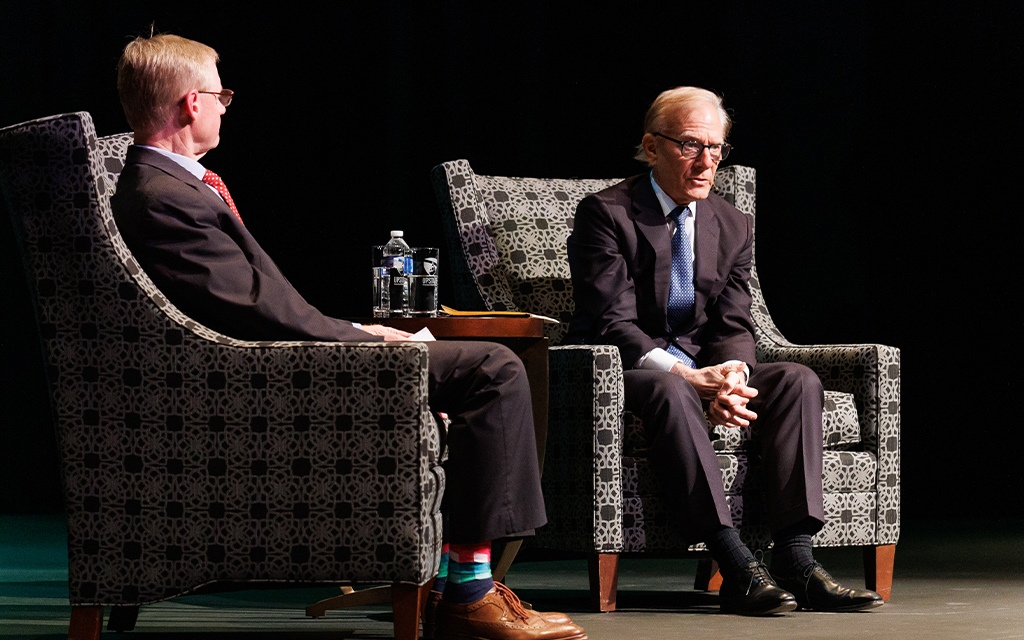
David Ignatius, columnist for The Washington Post, was the featured speaker at the 11th annual John B. Edmunds, Jr. Distinguished Lecture Series. The event was held at the Chapman Cultural Center Thursday, April 9. The series is hosted each spring by Upstate’s Department of History, Political Science, Philosophy, and American Studies.
Ignatius was joined on stage by Rob McCormick, a professor of history at Upstate, for a conversation on topics ranging from the current U.S. war with Iran, the Ukrainian war, US-China relations, the inspiration for Ignatius’ spy novels, and tips for writing.
As part of the discussion regarding the current war, he reflected on how little has changed in the Middle East over the past several decades.
“I’ve been covering the Middle East now since 1980, and I do have this feeling that I’ve been watching the same movie over and over again,” Ignatius said. “It’s a movie about the recurring cycles of violence in the region. It’s a movie about the limits of military power to achieve your goals.”
Later, he discussed the balance he found between working in news media and being a spy novelist. He shared that his novels are inspired by his experiences as a journalist. The inspiration for his first novel, “Agents of Innocence,” came during his time in Lebanon.
“I came 35 minutes from getting blown up by an Iranian car bomb that exploded the American embassy just after I left an interview there in 1983,” he said.
In the immediate aftermath of the bombing, survivors talked to Ignatius as a way of coping with their grief. In the process, they revealed the details of what he called “one of the biggest intelligence operations the CIA had run before or since in the Middle East.”
He tells a fictionalized version of that operation in the novel.
Earlier in the day, Ignatius talked about his career and held a Q&A session with a select group of students on the Upstate campus. He also answered questions from the audience during the evening lecture, including how he writes his books.

Responding to an audience member, Ignatius offered some advice about writing and creative work in general: “What’s creative is preconscious,” he said.
The best creative ideas, he explained, don’t happen when sitting down trying to think of them. They happen during some other physical activity.
“You just need to get out of the way,” he added.
After letting what he calls “this preconscious, incredibly creative, pattern forming thing” form ideas, Ignatius said the next step is to be very conscious when evaluating and editing those ideas.
Ignatius started his career with The Wall Street Journal in 1976, covering the steel workers union in Pittsburg. Four years later, he became the Journal’s Middle East correspondent. In 1986, he joined The Washington Post as editor of the Sunday Outlook section and later became assistant managing editor for business news.
He’s been writing his column for the Post since 1998. He also served as the executive editor of the International Herald Tribune in Paris for three years and is the author of 12 spy novels.
USC Upstate Chancellor Bennie Harris acknowledged event sponsors and guests during the evening.
“Thanks to our generous sponsors, we have the opportunity to engage with exceptional scholars, journalists, historians, and authors to deepen our collective understanding and sharpen our ability to navigate the complexities of our world,” Harris said.
In reflecting on the purpose of the lecture series, RJ Gimbl, vice chancellor for University Advancement, closed by encouraging guests to continue the discussion.
“Maybe it comes up in class for our students,” Gimbl said. “Maybe it comes up in conversation tomorrow or just sticks with you in a quiet way. That’s really the goal of this series, to start conversations and to keep them going.”