

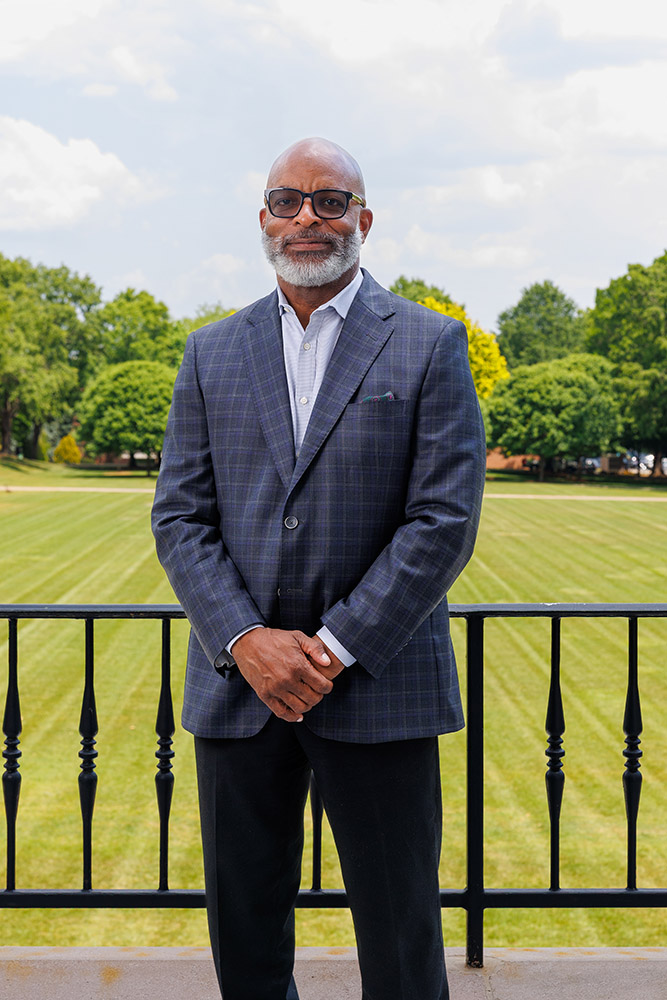
When former South Carolina Rep. Harold Mitchell decided to go back to school this past August to finish his bachelor’s degree, friends often asked him why. After all, they argued, most people get degrees to land a good job and he already had one.
It was a fair point. Mitchell has achieved many successes without a degree. His decades of public service include establishing ReGenesis, a nonprofit dedicated to improving health care and economic conditions in underserved communities; leading the cleanup of toxic chemicals in the Arkwright and Forest Park communities; and collaborating with federal and state lawmakers to secure millions in grant funding for neighborhood revitalization.
But as the years passed, Mitchell felt incomplete. “Deep down, it was like, ‘You’re missing something here,’” he says.
While attending different events in Spartanburg, Mitchell learned about the Re:Degree program, which offers a pathway to degree completion for people who have done some college coursework. He reached out to Debbie Little, the Re:Degree program advisor at USC Upstate, and within a few days Little had him registered for the fall 2025 semester.
She also gave him some straight talk. While friends had suggested Mitchell could take classes online while continuing his advocacy work, Little recommended he stay laser focused on his studies. “She’s like, ‘You can’t do all these things at the same time,’” Mitchell recalls. “‘You’re going to have to prioritize.’”
Mitchell was more than happy to oblige. He had attempted to re-enroll in college more than once in the past, and work had always gotten in the way. This time, he says, he removed himself from all leadership activities and told his contacts he would be focusing exclusively on classes between August and December.
He also wanted to take all his classes in person. Though he hadn’t been in a classroom since 1988, he was eager to interact directly with professors and students. “Getting in that classroom and actually listening to young folks, you really realize what you don’t know,” he says.
On his first day of class, Mitchell admits he was a little anxious. He was determined to be just like any other student and did not reveal his legislative or environmental experience to his classmates. “I didn’t wear suits or anything, and they thought I was literally an old person in the community,” he says with a laugh.
After getting comfortable with classroom technology and how to navigate classes, Mitchell found his fear and anxiety subsiding. Little continued to offer encouragement and support, as did his family. His two daughters, one of whom graduated from Upstate, would call and give him pep talks and reassure him before exams. Even when he knew the material, he admits he would sometimes doubt himself and second guess his answers.
The first time he got an A on a quiz he was thrilled. When he was in college the first time, “I never saw an A, not even in PE, so to get that first one became almost contagious,” he says.
He’d turn down offers to watch a football game so he could delve into research for class. He discovered a joy in reading he’d never had in his younger years. “This has hit a reset button of wanting to get engaged, wanting to make a difference, wanting to help folks,” Mitchell says.
Taking history with professor Rob McCormick and African American studies with adjunct instructor the Rev. Keith McDaniel helped Mitchell draw connections between past and current events that he had never noticed. When he took sociology with professor Colby King, he saw how community activism related to movements he’d learned about in his other classes.
For Mitchell, it felt like he finally had the context to make sense of all the lessons he’d picked up through years of experience in politics and advocacy.
“I never really just embraced or learned from the moment,” he says. “I was always just moving, constantly moving. And being busy. That busyness wasn’t good.”
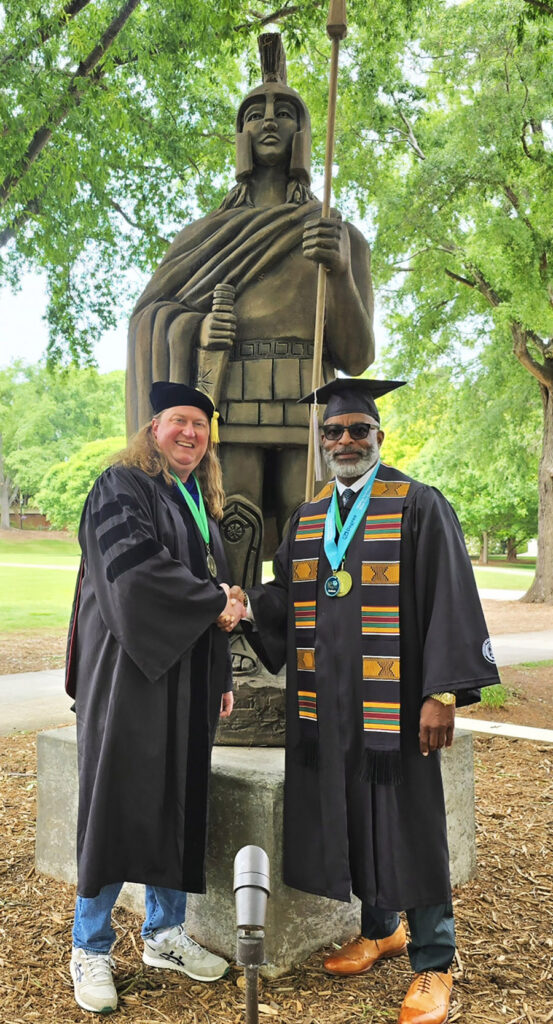
Mitchell is still processing what it means to finally have a degree. He will officially complete his coursework over the summer, but he will be walking in the spring ceremony. When he picked up his cap and gown, he felt the years fall away and he was an excited young man again. Though his mother had died during COVID, “The first thing I thought about was, ‘I can’t wait to get home and show my mom,’” he says.
Instead, Mitchell took his first semester grades to the cemetery. Standing by his mother’s grave, he told her, “Look, I did it. You can get off my back now, I made all these As. You can finally rest.”
Story by: Elizabeth Anderson, Director of Integrated Communications